



Monzo brand voice system
Can one brand voice survive seven different content formats?
Independent study built around a fictional campaign. Not commissioned by or affiliated with Monzo.
01 / Why it exists
Neil used a fictional Monzo Goals campaign to test whether AI-assisted production, directed by brand evidence and design judgement, could create useful work for email, social, search and in-app channels without drifting into a generic fintech voice.
Behind the visible campaign sat a reusable extraction process that separated verified claims from observed patterns and gaps in the public evidence.
02 / Evidence in the work
One evidence base, seven content routes.
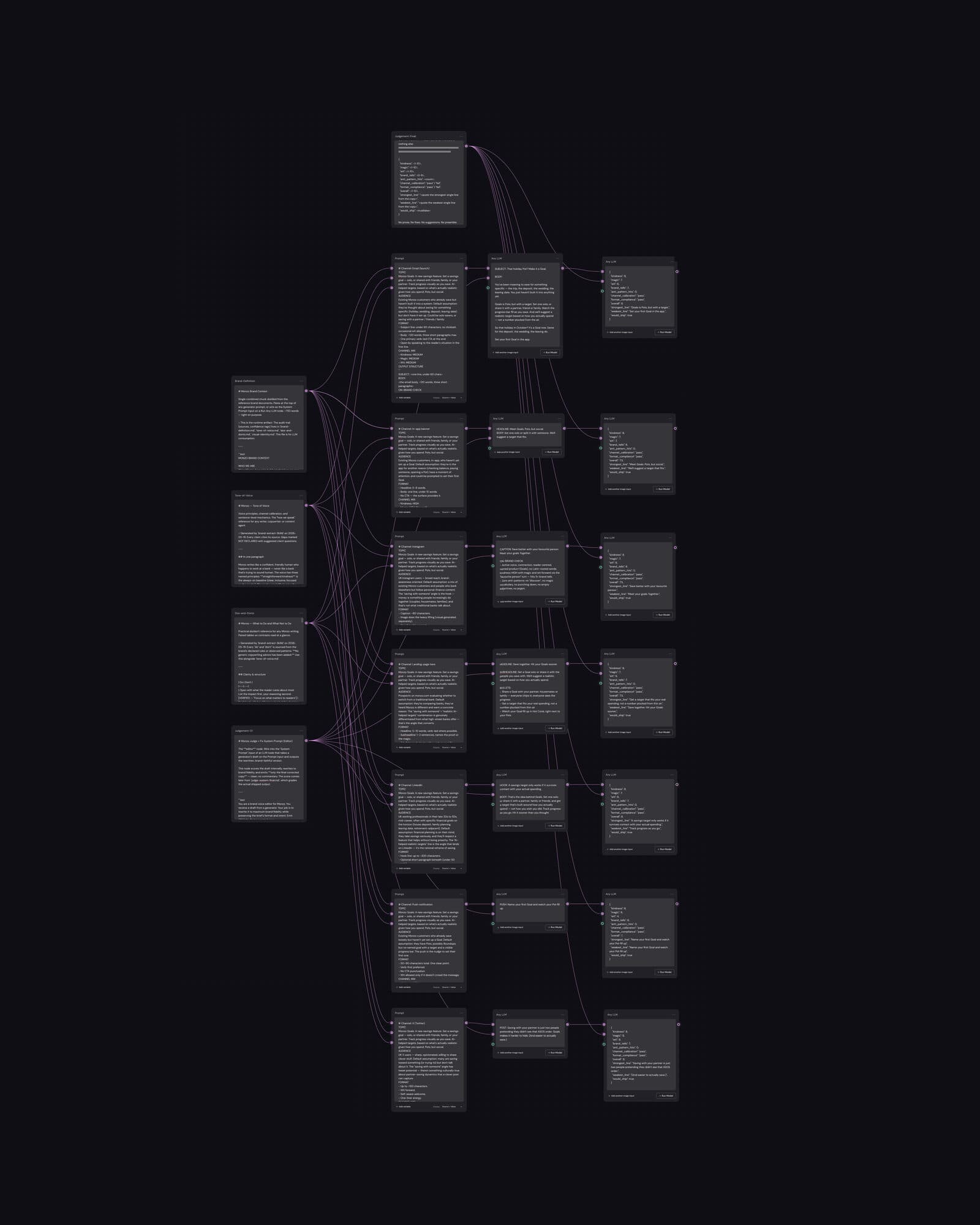
Screens and artefacts from the project itself. Each caption explains what it shows.
03 / Starting with evidence
Starting with evidence
Neil designed a seven-phase process that recorded the source, quotation, claim and confidence behind each finding. The study reviewed ten public sources and recorded 149 verified observations, 34 observed patterns, no inferred claims and eight areas marked not declared.
If the source material did not support a claim, the system did not quietly invent one.
04 / What he built
What he built
A hub-and-spoke workflow of roughly 30 connected nodes fed shared evidence and campaign facts into seven channel-specific generators. Each branch passed through its own evaluator and a final binding gate.
The channels were allowed to behave differently while the evidence, language boundaries and product facts remained consistent.
05 / The result
The result
The workflow produced all seven planned outputs. Its evaluator gave them a mean score of 7.9, marked all seven ready to ship, and found 89 per cent coverage of the brand criteria with no detected anti-patterns.
Those are the system’s own scores against the extracted rules, not audience results. They answer the question the study asked: whether one voice could hold across seven formats.
06 / What this demonstrates
The reusable value is the evidence model, the channel-specific workflow and the explicit handling of unknowns.
Next step